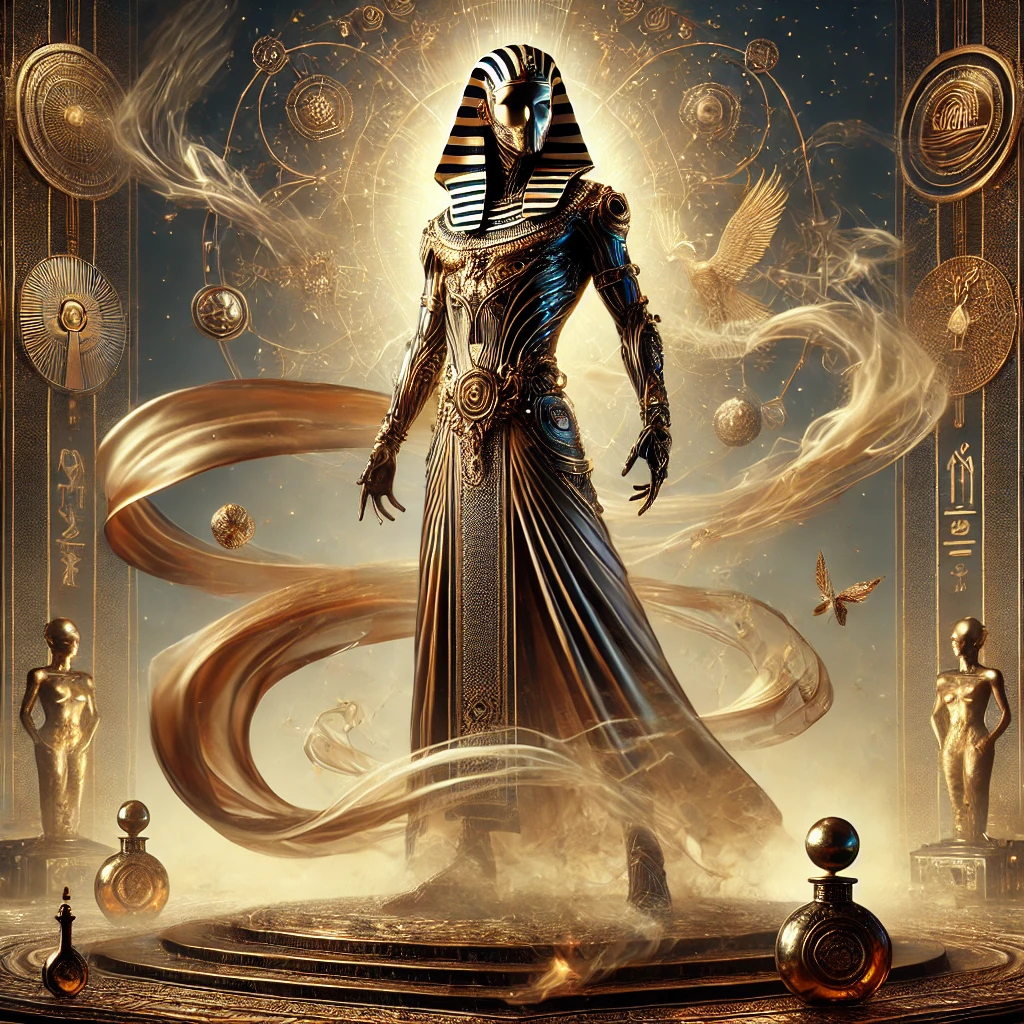
Shesmou : Egyptian divinity
Shesmou: Historical and archeological study of an Egyptian god
Introduction
Shesmou (also written Chesmou, Shesmu, Schesmu, Shezmou, Schezemu, Schesemu, Shesemu, Sezmu, Sesmu ou Šezmu) is a divinity from Ancient Egypt, whose role and representation evolve over millennia of Egyptian civilization. This study aims to present the historical and archeological aspects of this complex deity,drawing on available textual, iconographical and archeological available sources.
1. First attestations and historical development
Predynastic era and Ancient Empire
The first mentions of Shesmu date back to the Ancient Empire (2700-2200 BC), especially in Pyramid texts, which are the most ancient corpus of egyptians religious texts. The 403 formula from Pyramids texts (Pyr. §§ 697-699) refers to Shesmu as a deity associated with press houses and to the blood of the enemies from late pharaoh. (Faulkner, 1969).
According to egyptolog Herman te Velde (1977), Shesmu was probably a local deity whose cult developed in the Memphis area, one of the oldest capitals of Egypt.
Middle Empire and New Empire
During the Middle Empire (2033 – 1786 BC), Shesmu appears in the Coffin texts, where its deity associated with perfumes and sacred oils role is more developed. The formula 941 of Coffin texts mentioned him as “Lord of perfumed oils” (Barguet, 1986).
During the New Empire (1550 – 1069 BC), references to Shesmu appear in Book of Death (chapter 17) and in various royal funerary texts, notably in the tombs of the Valley of the Kings (Hornung, 1999).
Late Period and Ptolemaic Kingdom
In the Late Period (664-332 BC) and during the Ptolemaic Kingdom (332-30 av. J.-C.), Shesmu is mentioned in texts of the temples, like in Denderah and Edfou. est mentionné dans les textes des temples, particulièrement à Dendérah et à Edfou. The temple of Edfu contains inscriptions describing the rituals of preparing sacred oils under the protection of Shesmu (Chassinat, 1928).
2. Nature and functions of the deity
Master of the press house
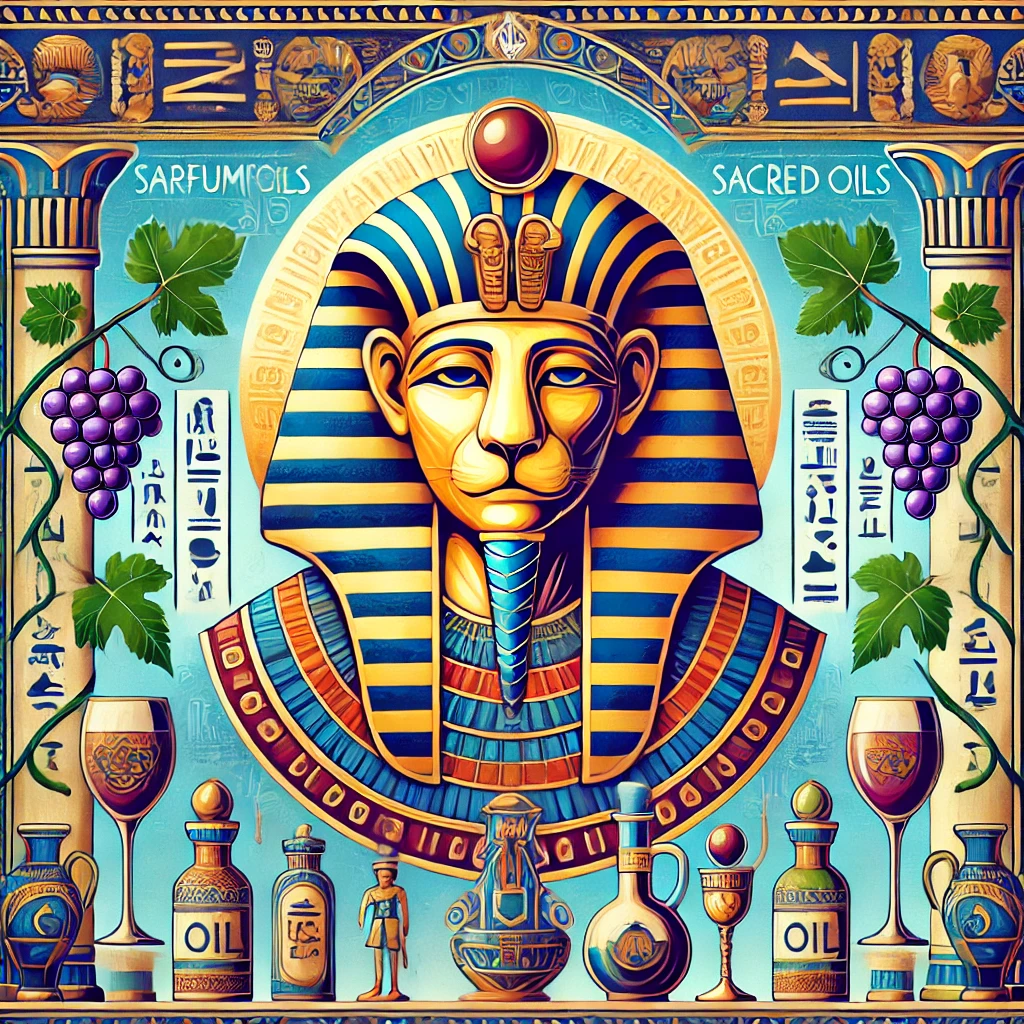
Shesmu’s primary function is that of “Master of the press.” This appellation, attested in numerous religious texts, designates him as the deity presiding over the extraction of grape juice for the production of wine, but also over the extraction of vegetable oils used in the manufacture of sacred perfumes and ointments.(Manniche, 1999).
Deity of perfumes and sacred oils
According to Lise Manniche (1999) in her book Sacred Luxuries: Fragrance, Aromatherapy, and Cosmetics in Ancient Egypt, Shesmu was revered as the protector of the processes of extracting plant essences. The oils produced under his protection were used for :
- Religious and Funeral Rituals
- Embalming of the Dead
- Royal and Divine Anointings
- Cosmetic Treatments
Ambivalent deity
A notable characteristic of Shesmu is his dual nature. On the one hand, he is a benevolent deity, providing essential products for worship and the preservation of bodies. On the other hand, funerary texts describe him as a fearsome entity, “one who squeezes the blood of enemies as one squeezes grapes.” (Willems, 1996).
This duality reflects the Egyptian conception of natural forces, both creative and destructive. Dimitri Meeks (2003) emphasizes that this ambivalence is common among deities associated with transformation processes.
3. Iconography and Archaeological Representations
Anthropomorphic representations
Depictions of Shesmu are relatively rare compared to other deities in the Egyptian pantheon. When he is depicted, he generally appears in two main forms:
- Human form: In some representations, notably on papyri from the New Kingdom, Shesmu is depicted as a man wearing the crown of Lower Egypt or a simple wig (Wilkinson, 2003). According to Wikipedia, he is also depicted with his arms laden with jars.
- Leonine form: More frequently, he is represented as a man with a lion’s head, sometimes holding a knife, symbolizing his fearsome aspect (Hornung, 1982).
Pressing scenes
Depictions of the pressing process, under the implicit protection of Shesmu, are visible in several private tombs, including:
- The tomb of Petosiris at Tuna el-Gebel (4th century BC)
- The New Kingdom Theban tombs TT52 (Nakht) and TT217 (Ipuy)
- The tomb of Kheti at Beni Hassan (Middle Kingdom)
These scenes show people using torsion presses to extract grape juice or vegetable oils (Murray, Boulton & Heron, 2000).
Archaeological items
Few archeological items are directly linked to Shesmu. However, oil and wine presses have been discovered in various archaeological contexts, including:
- An olive oil pressing installation at Tell el-Balamun (Late Period)
- Remains of wine presses at Abydos and Tell el-Amarna
- Containers of ointment bearing inscriptions mentioning Shesmu were identified in the treasure of Tutankhamun (Carter & Mace, 1923–1933).
4. Cult and Places of Worship
Cult Centers
Although Shesmu did not benefit from a cult as widespread as that of other major deities such as Osiris or Amun, several centers have been identified as places of his worship:
- Memphis: Considered the main center of his cult, particularly in the artisanal district where perfumes and sacred oils were produced (Zivie, 2009).
- Dendera: The temple of Hathor at Dendera contains references to Shesmu as a deity associated with the production of ritual oils (Cauville, 2001).
- Abusir: Mentions of Shesmu have been found in the solar temple of Niuserre (5th Dynasty).
Associated rituals
The rituals linked to Shesmu were primarily connected to the production of wine and sacred oils. Texts from the temple of Edfu describe in detail the preparation of the “Seven Sacred Oils” used in daily rituals and embalming ceremonies (Goyon, 1972).
5. Theological aspects and relationships with other Deities
Divine associations
Shesmu maintains theological connections with several other deities:
- Horus: In some late texts, Shesmu is assimilated to an avenging aspect of Horus, protecting his father Osiris (Junker, 1958).
- Khenty-Khety: This crocodile deity from Letopolis shares with Shesmu certain violent and protective aspects (Meeks, 2003).
- Min: A god of fertility, he is sometimes associated with Shesmu in agricultural contexts related to wine production (Gauthier, 1931).
- Osiris: As a god of wine, Shesmu is linked to the Osirian cycle of death and rebirth, with wine symbolically connected to the blood of Osiris (Griffiths, 1980).
Mythological significance
The duality of Shesmu reflects the Egyptian concept of transformation: extracting precious substances (wine, oil) requires a form of violence (pressing, crushing). This duality also symbolizes the cycle of life and death, a central theme in Egyptian religious thought (Assmann, 2001).
Conclusion
Shesmou represents a fascinating example of a specialized deity in the Egyptian pantheon. His association with the production of wine and sacred oils highlights the importance of these substances in the religious and funerary practices of ancient Egypt. His ambivalent nature—both beneficent and fearsome—reflects the complexity of Egyptian religious thought and its understanding of natural forces.
Although less well-known than other major deities, Shesmu held a significant place in the Egyptian religious world, particularly in ritual and funerary contexts where perfumes, ointments, and wine played an essential role.
Although less well known than other major deities, Shesmu occupied a significant place in the Egyptian religious universe, particularly in ritual and funerary contexts where perfumes, unguents and wine played an essential role.
Bibliography
- Assmann, J. (2001). The Search for God in Ancient Egypt. Cornell University Press.
- Barguet, P. (1986). Les Textes des Sarcophages égyptiens du Moyen Empire. Éditions du Cerf.
- Carter, H., & Mace, A. C. (1923-1933). The Tomb of Tut.ankh.Amen. Cassell & Company.
- Cauville, S. (2001). Dendara : Le Temple d’Isis. Institut français d’archéologie orientale.
- Chassinat, É. (1928). Le Temple d’Edfou. Institut français d’archéologie orientale.
- Faulkner, R. O. (1969). The Ancient Egyptian Pyramid Texts. Oxford University Press.
- Gauthier, H. (1931). Les fêtes du dieu Min. Institut français d’archéologie orientale.
- Goyon, J.-C. (1972). Rituels funéraires de l’ancienne Égypte. Éditions du Cerf.
- Griffiths, J. G. (1980). The Origins of Osiris and His Cult. Brill.
- Hornung, E. (1982). Conceptions of God in Ancient Egypt: The One and the Many. Cornell University Press.
- Hornung, E. (1999). The Ancient Egyptian Books of the Afterlife. Cornell University Press.
- Junker, H. (1958). Der grosse Pylon des Tempels der Isis in Philä. Österreichische Akademie der Wissenschaften.
- Manniche, L. (1999). Sacred Luxuries: Fragrance, Aromatherapy, and Cosmetics in Ancient Egypt. Cornell University Press.
- Meeks, D. (2003). Les Dieux et démons zoomorphes de l’Égypte Ancienne. In Revue de l’histoire des religions, 220(2), 183-196.
- Murray, M. A., Boulton, N., & Heron, C. (2000). Viticulture and wine production. In P. T. Nicholson & I. Shaw (Eds.), Ancient Egyptian Materials and Technology (pp. 577-608). Cambridge University Press.
- te Velde, H. (1977). Seth, God of Confusion: A Study of His Role in Egyptian Mythology and Religion. Brill.
- Wilkinson, R. H. (2003). The Complete Gods and Goddesses of Ancient Egypt. Thames & Hudson.
- Willems, H. (1996). The Coffin of Heqata (Cairo JdE 36418): A Case Study of Egyptian Funerary Culture of the Early Middle Kingdom. Peeters Publishers.
- Zivie, A. (2009). La Tombe de Maïa, mère nourricière du roi Toutânkhamon et grande du harem. Caracara Edition.